Nov 30 • Landi Callender-Easby
Avoiding common pitfalls: Insights from our CIMA Strategic Case Study exam marker
The CIMA Strategic Case Study (SCS) exam is designed for you to showcase your proficiencies and apply what you have learned throughout your studies to various scenarios. The exam is a challenge not to be underestimated, and this is reflected in the May-25 pass rate of only 53%.
Editor’s note
As an SCS marker, I have put together a host of common pitfalls to avoid, which cost candidates the most marks. Hopefully, these pointers will help you pass the SCS exam.
Reading & comprehension
The main reason students struggle to pass this exam comes down to the reading and comprehension of the question requirements. In order to pass, you must answer what has been asked and not what you wish or hoped had been asked. During your exam, you can write a brilliantly elaborate answer with enough content, whilst referencing the pre-seen material and applying theory to the scenarios given. If, however, the information given does not answer the question that was presented to you, you will receive very few to zero marks. Given that a considerable amount of time would have been spent formulating the answer to the question, it will result in the loss of both marks and time. This is a challenging scenario to find yourself in, and one which could potentially lead to the failure of the SCS exam.
Understandably, on exam day, your nerves will be high, but spend enough time reading the questions so that you have a good comprehension of what is being asked of you. Hopefully, this will allow you to build up some confidence and bolster your ability to directly respond to the question being asked. If you find that you may have some time to spare, refer back to the specifics and keywords of the particular question and ensure that your answer addresses the question directly. Learning how to read and interpret questions is a skill that comes from question and mock exam practice.

Time management
Candidates often assume a question is guiding them towards a particular model mentioned within the theory of the three pillars, leading up to the SCS. They refer to the explanation of the model and the details as to how it works, erroneously assuming that this will lead to good marks and a great result. This is, however, a misconception which will instead cost the candidate precious time and result in very little to zero marks. Markers assume candidates know their theory. Candidates must demonstrate how this theory can be applied to the question scenario presented.
It is important to plan how much time you will spend on each subtask before commencing with your answer.
Spend a few minutes reading the question very carefully and making sure you fully understand the question requirement. Candidates often start Subtask A with enthusiasm and provide a lot of content, especially when they feel confident they can do well in the first subtask. However, time lapses very quickly in the SCS, and you might find yourself at the end of your allocated hour with a great answer for Subtask A without having attempted Subtask B. Take care not to lose out on valuable marks by planning your time per subtask. If you find that your time has run out in Subtask A, move on to Subtask B and be very strict with yourself about this. If you have some time remaining after attempting both subtasks, you will have the opportunity to revisit Subtask A and wrap up your answer.
Focus
The level of difficulty of questions in the SCS fluctuates. Candidates might be faced with a scenario where their first two subtasks in section one go really well, and suddenly, when faced with section two, they don’t understand the first subtask. They struggle to think of any valid points to raise, or their mind goes blank. Many candidates will permit this challenge to set the tone for the rest of their exam, and it is evident to the marker that the candidate has given up. There is a high probability that you may be faced with a similar scenario in the exam, and this could happen during the first section.
It is extremely important to persevere. Skip to the next subtask and revisit the problematic subtask once some confidence has been gained. This will also give you a few moments to calm down and carefully consider how to approach the question you struggled with. The SCS exam is a marathon, and mock exam practice is like marathon training. You must be strong enough mentally to overcome this hurdle. Even if you score zero marks in one subtask, there is still a possibility of passing if you do well enough in the remaining questions.
Depth
Raising a point and only offering a brief explanation will not score many marks, unfortunately, even if the point raised is correct. The bulk of the marks is allocated to the detailed evaluation and application of the points raised in response to the question scenario presented. This difference in applied content is what vastly sets candidates apart in their final exam scores. It is important to let the question’s mark allocation be your guide in how much content should be provided. Typically, for a subtask worth 60%, four to five points raised and evaluated in detail would score well. It is just as important not to raise too many points in the answer, either, as the marking grids would not require so many different points to be identified. An example of this would be raising nine points in a subtask worth 50%. The SCS is a time-pressured exam; thus, it is vitally important to allocate time to value-adding activities, such as giving enough information to count, but not too much to affect the result of the rest of the exam.
When arriving at section three, it is important that you don’t become complacent because you are nearing the end of your exam. Approach the last section with confidence and the necessary concentration to finish well. After all the preparation and sacrifice, complete the exam to the best of your ability. Write the amount of content required by the mark allocation, taking into account the time factor.

Scenario application
Every six months, CIMA creates a new fictitious company to base questions on, known as the pre-seen materials. Make sure you know at least the basics of the pre-seen material. This will include the company’s gearing ratio; the number of executive directors compared to non-executive directors; the current share price and whether it has been in decline or appreciated in recent years; the company’s mission, vision and values; whether it is a listed entity; where it is based and the currency in use, to name but a few.
Where it is applicable and to further substantiate your answers, highlight these facts, ratios and data. In doing this, you will set yourself apart from more diluted answers from other candidates. Referencing incorrect data on the pre-seen material reflects poorly on your comprehension of the company you are supposed to represent. It may also decrease your marker’s leniency, as this indicates that you have not put in enough time or effort reviewing these materials, and as a result, they will be less inclined to give you the benefit of the doubt when marking your answers.
Introductions and conclusions
Generally, an introductory and a concluding paragraph are not required. Often, a candidate will start their answer with an explanation of what they think the question is asking, or they will write a conclusion at the end of the answer regarding the decision they feel is best in the given scenario. Unless specifically asked to do so, stay away from a solution or a recommendation, as these time wasters will score you very little to no marks. Always ensure you answer the question directly.
Verbs
When asked to ‘evaluate’, you are asked to provide a balanced view. CIMA likes the idea of candidates being able to debate both sides of the presented scenario in questions, such as arguments for and arguments against. Often, the marking grids are set up in this way. Take care to answer accordingly, as you might lose out on valuable marks when not discussing both the benefits and drawbacks of a statement or question. In some instances, though, there may not be another side to debate, for example, “evaluate the currency risks of operating an overseas entity”.

Layouts
Having a well-structured layout of your exam answers will not score you any marks, but it will help set up a good rapport between you and your marker.
As a marker, when I go to review a question paper and the layout is incredibly messy, I immediately feel disheartened.
This is because I know it will take me a considerable amount of time to figure out which subtask is being answered, and it is challenging to read and comprehend. Markers go through hundreds of papers, and when reviewing a paper, they want you to do well. It therefore makes sense for you to make it easy for them! It is of high importance to clearly label which question and subtask you are answering and ensure the spacing between paragraphs makes it easier for markers to read. This will help set you up for a successful result in the exam.
Exam day
Arrive at your exam venue at least half an hour to an hour before you are due to start writing. On exam day, you will be feeling very nervous, and any additional anxiety can be prevented by making sure you arrive at the venue with enough time to spare. It is important to plan for traffic and any unforeseen occurrences. Getting to the exam venue late will give you a bad start and could cause you to read the questions incorrectly due to time constraints.
Speaking from my own experience, I planned to go and see where my booked venue was a week before the exam and thank goodness I did! I followed Google Maps, but when I arrived at my destination, I could not find the exam venue. I asked around, and no one knew what I was talking about. It took me about an hour to drive from street to street and walk from building to building until I eventually found the exam venue. It turns out the placement marker on Google Maps was incorrect, and it had not been corrected. This one small factor can completely undo all your time, effort and preparation. This is definitely a situation to avoid on exam day!
Closing advice
This could be the last exam you ever have to write. All the weekends and late nights of studying, juggling work, family and friends’ commitments will not be in vain. Many candidates dread the idea of attempting this challenging exam, but rest assured that all the preparation, effort and sacrifice will be well worth it. If you have attempted this exam previously and were unsuccessful, do not give up! Try until you succeed. Follow the proper channels and ask for help.
Passing the SCS is an unparalleled feeling, and once you receive your credentials as a qualified professional, this will broaden your horizons both academically and in the workplace.
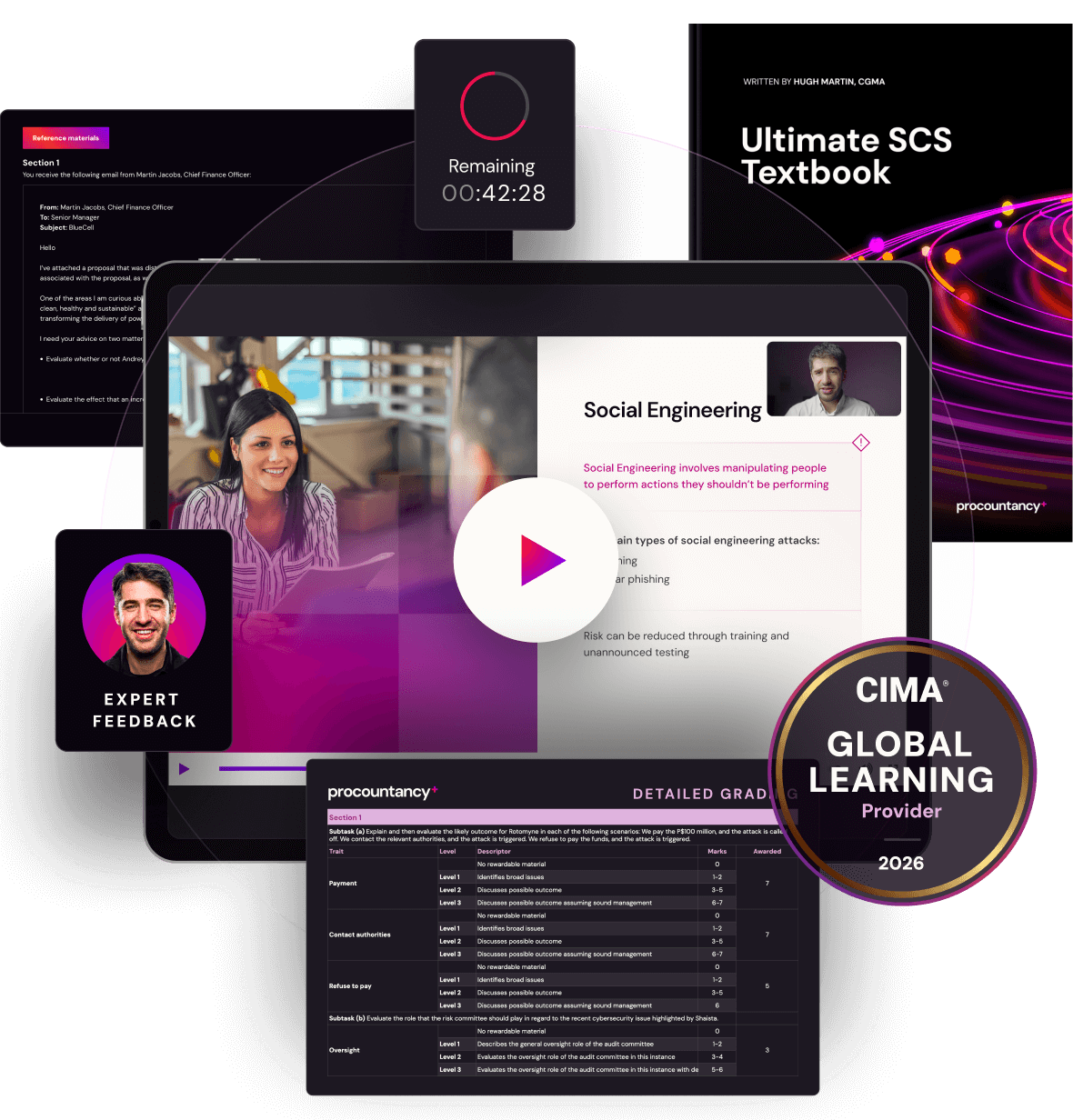
Ultimate Strategic Case Study Course

-
Full SCS-specific theory coverage
-
Extensive pre-seen and industry coverage
-
Over 45+ ultrarealistic questions
-
Core activity application videos
-
Access to our SCS digital textbook
-
Pass assurance

Procountancy Copyright © 2026
Subscribe to our newsletter now!
Get weekly updates on live streams, news and more right in your mailbox.
Thank you!