Apr 12 • Hugh Martin
CIMA SCS Pre-seen insights: Kwirtmak (May-26/Aug-26)
The pre-seen for the upcoming May-26 / Aug-26 CIMA SCS exam is based on a company called Kwirtmak, which builds commercial 3D printers and is based in the country of Ennland.
Product design
Industry
3D Printing is a technology used to construct physical objects layer by layer from digital designs and various materials. The item is created in thin layers until the desired product is complete. 3D Printing is also referred to as additive manufacturing.
Both in the pre-seen and in the real world, end-product specifications are digitally designed in Computer-Aided Design (CAD) software. Various sizes of 3D printers can be used to produce an array of products from different materials, according to the designer’s specifications. A 3D printer can create complex individual objects quickly and accurately at a significantly lower cost than traditional manufacturing methods. However, creating these designed products can be less cost-effective with 3D printing than with traditional manufacturing methods when manufactured in bulk.
The design process can be accelerated by using a 3D scanner to scan an existing object that requires modification. The scanner creates a digital file that can be modified in 3D CAD software. This is faster than designing an end product from inception in a blank file. Once the digital designer is satisfied with the CAD design specifications, the software splits the unit into many thin layers. The finalised file is then sent to the 3D printer for printing. Complex shapes might require temporary supports added to the design during printing until the final object cools and hardens, allowing the supports to be stripped out.
In the real world, the 3D printing industry is transitioning rapidly from prototyping to scalable production, driven by AI-enhanced design and faster production technologies. There is a high demand for customisable parts within the medical, aerospace and automotive industries. The 3D printing industry is expected to grow significantly in the years to come. The challenges the industry faces include limitations in materials, regulatory issues, intellectual property theft, cost, speed, and printing consistency.
Types of 3D printers
Each different type of printer uses a unique material.
There are six types of 3D printers:
-
Extrusion – This is one of the most well-known 3D printers. The printers themselves are generally small and can produce a reasonable quality end product. The unit is created from plastic filament, which is fed into an extrusion head. During this process, the extrusion head melts the plastic and builds the final object layer by layer, with each layer hardening before bonding to the next. Temporary support structures may be required during construction until the final product has cooled down and hardened. Extrusion printers may have many extrusion heads and can therefore combine materials within a unit.
-
Stereolithography (SL) – This printer produces one of the most accurate printing processes and uses photopolymer resins. A laser is stationed above a tank of liquid resin, which can be raised to the surface by a motorised platform within the same tank. The platform is lowered in minor increments, and the laser beam is directed over the liquid resin, layer by layer, until the object is fully constructed. Temporary support structures may also be used during unit construction, and the final product may require additional hardening by exposing it to laser light.
-
Digital light processing (DLP) – This is a similar printing process to stereolithography, but a more traditional light source is used to cure the final product, with a lens and mirror rather than a laser. In the real world, DLP printers tend to be cheaper to produce, but SL printers are generally more accurate.
-
Laser melting – This printer can produce objects from both powdered plastic and metal materials, and the units may be stronger than those made by SL and DLP printers. However, the surfaces of units produced by these printers can be rougher, and the printing itself may not be as precise. A laser melting printer consists of two chambers, called the build and powder chambers, with platforms that can be raised gradually by pistons. At the start of the build, the piston in the powder chamber rises incrementally, and a roller spreads a thin layer of powder on the building platform, which is subsequently compacted by the roller's weight. The laser above the building platform melts and fuses the first layer of powder, creating a hardened layer. The process repeats until all the layers have been constructed and bound, and the building tank is left to cool. Laser melting printers do not require support structures during 3D printing.
-
Binder jetting (multijet) – There are two types of multijet printers: binder jetting and material jetting. Objects produced by these printers are not as strong as those produced by laser melting printers. Multijet printers do not require temporary support structures during construction, as their setup is similar to that of a laser melting printer. Binder jetting bonds specific areas of powder with a liquid, triggering a chemical reaction that creates layers of the construction unit. Binders are available in different colours, allowing multicoloured end products. Binder jetting printers use a broad range of materials.
-
Material jetting (multijet) – Material jetting printers create accurate, smooth surfaces by combining various materials. Each layer is created when a printhead deposits a layer of liquid or molten material, typically a polymer, onto a building platform. Each layer is preserved using ultraviolet light, with the process repeating until the object is fully constructed.
3D Printing materials
There are three types of materials that are used in the 3D printing process:
-
Plastics are used in either powdered or filament form (a slender continuous thread-like strand that can be melted or extruded). Nylon is available in both powder and filament forms, resulting in strong, bendable products. Powdered nylon can be combined with powdered aluminium to create alumide, a composite material. Nylon provides the base material, giving the end product both flexibility and toughness, and aluminium powder serves as a filler, adding rigidity and a metallic feel to this heat-resistant combination. ABS is an extremely tough form of plastic, used in filament form in extrusion printers. PLA is a form of biodegradable plastic that is supplied in resin form for use in both Stereolithography (SL) and Digital Light Processing (DLP) 3D printing. PLA is a solid filament that melts when heated and hardens as it cools.
-
Metals are supplied in powder form for 3D printing. The following metals can be used: aluminium, cobalt, stainless steel, gold, silver, and titanium. The characteristics of these metals are different depending on their use and application. These metals allow for intricate designs in products like jewellery as they are lightweight and corrosion-resistant.
-
Ceramics are very hard materials made from non-metallic, inorganic substances like clay, minerals or oxides. They are hardened by high heat sources. Ceramics are available in different forms, allowing them to be used with all printer types noted earlier, except SL. Once the finalised product is 3D printed, it must be fired like any other ceramic product. Examples of ceramics include glass and clay.
Benefits
There are several potential benefits associated with 3D printing.
-
Customisable units can be produced more sustainably by being printed on customers’ premises, reducing transportation costs.
-
Products can be made to exact specifications, decreasing what would have been production waste.
-
3D printing offers flexibility, enabling complex objects to be produced quickly and saving time and costs, as low-volume production can be time-consuming and expensive.
-
Prototypes can be created quickly and with relative ease, which helps fast-track research and development projects.

Company
Operations
Kwirtmak manufactures a variety of 3D printers, including:
-
Extrusion
-
Stereolithography
-
Digital light processing
-
Laser melting, and
-
Material jetting
Their focus is on creating printers for commercial customers from a wide range of industrial backgrounds, including:
-
Aerospace,
-
Consumer electronics,
-
Automotive, and
-
Jewellery.
A larger printer can print larger objects, and Kwirtmak’s largest extrusion printer can create objects with a build volume of up to 1 metre cubed. Kwirtmak can also supply its customers with the materials needed for 3D printing. Customers do have a choice of where to source their printing materials. However, many clients prefer to procure these products directly from Kwirtmak because they know the materials will be compatible with the 3D printers they have purchased and that the quality will be superior.
Kwirtmak’s biggest factory and head office is based in Ennland, with its head office in the capital city. Kwirtmak has three other factories based abroad in different locations, and they sell to an international market. They provide expert technical advice to customers when choosing the specifications for their printers to be manufactured, consistent with targeting a higher-end customer base. This strategy is reflected in the prices of both their printers and the printing materials sold to customers. Kwirtmak’s printers are made from the highest-quality components and expertly assembled.
Customers can choose the properties of the output that their newly manufactured printers produce. Speed and cost are not the only factors to consider.
Properties of 3D printer output include:
-
Accuracy – Depending on the customer's requirements, printers can be constructed to provide extreme precision, down to a small fraction of a millimetre.
-
Finish – Select customers may need their printers to apply certain finishes to the final product, for example, a particular smooth surface or a unique colour scheme.
-
Strength – Certain combinations of printers and materials can create objects that are very strong, and the durability of the end product depends on how the materials react to moisture, heat and low temperatures.
-
Size – Customers may require their printers to create large objects. The 3D printer’s actual size may limit its printing capabilities, thus end products may have to be printed in multiple parts and assembled post-printing.
Kwirtmak’s expert technical advice helps customers make these challenging decisions when choosing their printer properties.
Strategy
Kwirtmak’s mission is to transform its customers through innovation in design and production.
Kwirtmak’s vision is to be the leading provider of additive manufacturing solutions across industries, to be achieved in a sustainable manner.
Kwirtmak’s values are as follows:
-
Creates wealth and success
-
Innovations are driven by customer need
-
Overdelivers on promises to its customers
-
Trusts its staff
-
Staff are team players
Governance
The governance structure is as follows:
-
Five executive directors
-
Four non-executive directors
There are four board committees:
-
Audit committee
-
Risk & Corporate Social Responsibility (CSR) committee
-
Remuneration committee
-
Nomination committee
Each committee has three non-executive directors. The Chair sits on the audit committee, which is contrary to the UK Code of Corporate Governance (2024).
The chief internal auditor reports to the convenor of the audit committee, which indicates that the company
-
Has an internal audit department
-
Exercises good governance, as this helps to mitigate intimidation and familiarity risk for the internal audit department
Financials
Kwirtmak year-on-year comparisons:
-
Revenue growth -19%
-
Operating profit -27%
-
Net profit after tax -29%
Kwirtmak key ratios:
-
Tangible non-current assets to total non-current assets 81%
-
Gearing (D/D+E) 39%
-
Effective interest rate 8%
-
Dividend payout ratio 53%
Breskko is Kwirtmak’s closest competitor in terms of the range of 3D printers and materials it sells. They are also based in Ennland and listed on the local stock exchange. The other six main competitors in the industry are based internationally but compete in the same markets as Kwirtmak.
Breskko year-on-year comparisons:
-
Revenue growth +10%
-
Operating profit +9%
-
Net profit after tax +9%
Breskko key ratios:
-
Tangible assets to total assets 81%
-
Gearing (D/D+E) 30%
-
Effective interest rate 8%
-
Dividend payout ratio 70%
By comparing Kwirtmak’s year-on-year information and ratios with Breskko, we can conclude that Kwirtmak’s financial results are not aligned with industry standards. Unfortunately, we are not provided with reasons for this, but there has been a considerable reduction in revenue and profits.
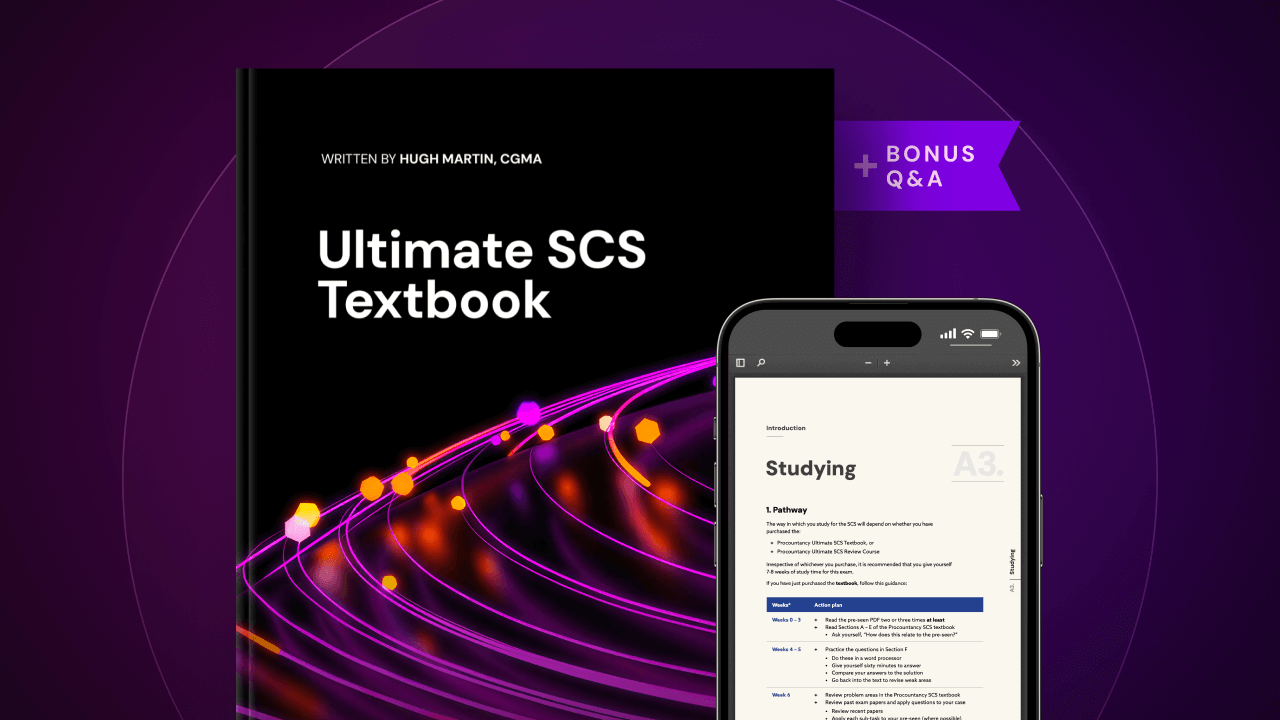
Take your preparation further.
Share price
Kwirtmak’s share price has fluctuated over the last five years.
Peak share price June 2021 at E$530.00
Trough share price March 2025 at E$30.00
We are not privy to information driving the share price volatility over recent years. These fluctuations could be due to a myriad of factors, including sales demand volatility, missed financial targets, and reputational damage. It is important to note that the share price has declined sharply over the last two years.
The company’s beta is 2.3, indicating that its share price is more volatile than the overall market, on average.
Sustainability report
Sustainability is becoming a more significant topic within the CIMA syllabus. Kwirtmak’s sustainability report mentioned that the company takes sustainability practices quite seriously, and that the board has delegated oversight of sustainability issues directly to the Operations Director. The Risk and CSR Committees also monitor sustainability issues on behalf of the board, and the Operations Director must provide feedback on any risks during scheduled board meetings.
Compliance with environmental legislation is paramount for Kwirtmak. All staff have been trained on potential environmental issues within their roles, and they are authorised to stop operations if they observe any significant environmental concerns.
The report highlighted the potential benefits of 3D printing, including the efficient use of manufacturing materials enabled by precise design specifications for objects. Certain plastics used in 3D printing can also be recycled into new filament, and 3D printing helps reduce the carbon footprint by minimising transportation.
Supplementary
Additional information
The ‘Happy Comic’ articles in the pre-seen document are generally used to provide supplementary information on the industry.
In this instance, the article explains that specific sizes and types of 3D printers are made to produce a limited range of end products. Not all 3D printers can be used interchangeably to create what the user requires. The article also highlights that 3D scanners improve the precision of object design, and 3D printers can help users create uniquely personalised items.
The pre-seen mentions that manufacturers of carbon fibre have seen high demand for their product. Carbon fibre is a high-performance material used in industrial applications and can help customers create composite materials for 3D printing. Carbon fibre is often used in the automotive, aerospace and sporting industries. It is approximately five times stronger than steel, lightweight, and it is valued for its high chemical resistance.
Medical use
Doctors and dentists have become increasingly dependent on 3D printing to create replacement parts tailored to their patients’ needs. Medical implants can be used to treat a range of conditions, including replacing heart valves, creating artificial limbs, and providing dental implants. Urgent treatment may be needed, and 3D printing these objects can assist in patient care. Expertise is required in the design of these medical devices to ensure seamless alignment with patients' exact needs. Skilled technicians assist doctors with entering the required design information into CAD software before proceeding with the printing. This process is much quicker than waiting for traditional external manufacturers to produce these items. It is noted that the materials used in these medical applications must be submitted for approval to the Ennlandian Health Service (EHS).
Potential Scenarios
Legislation changes
Questions could be asked about the:
-
Approval of medical material applications used in 3D printing by the Ennlandian Health Service and the scalability implications
-
Stricter environmental legislation of manufacturing materials used and supplied
-
Internal audit team to spearhead the investigation of a breach in health and safety or environmental legislation
Industry Constraints
3D printing construction is a niche market with limited suppliers, materials and technical support available to Kwirtmak
Questions could be asked about the:
-
Supply issues of printing materials affecting Kwirtmak and its customers
-
Quality issues and breakdowns of Kwirtmak’s printers
-
Cyber attacks on Kwirtmak’s 3D printers sold to customers
-
Drastic reduction of sales demand due to reputational damage
Other factors
Questions could be asked about the:
-
Acquisition of a carbon fibre supplier
-
Opening of a new production facility abroad
-
Overseas loan raised to pay a fine related to a breach in environmental legislation
-
Hostile takeover by Breskko due to Kwirtmak’s declining performance
-
Sustainability metrics are questioned by an outside pressure group
-
Intellectual property that was stolen from a customer


Procountancy Copyright © 2026
Subscribe to our newsletter now!
Get weekly updates on live streams, news and more right in your mailbox.
Thank you!